Endotoxins
Understanding bacterial toxin exposure in indoor dust and water-damaged buildings.
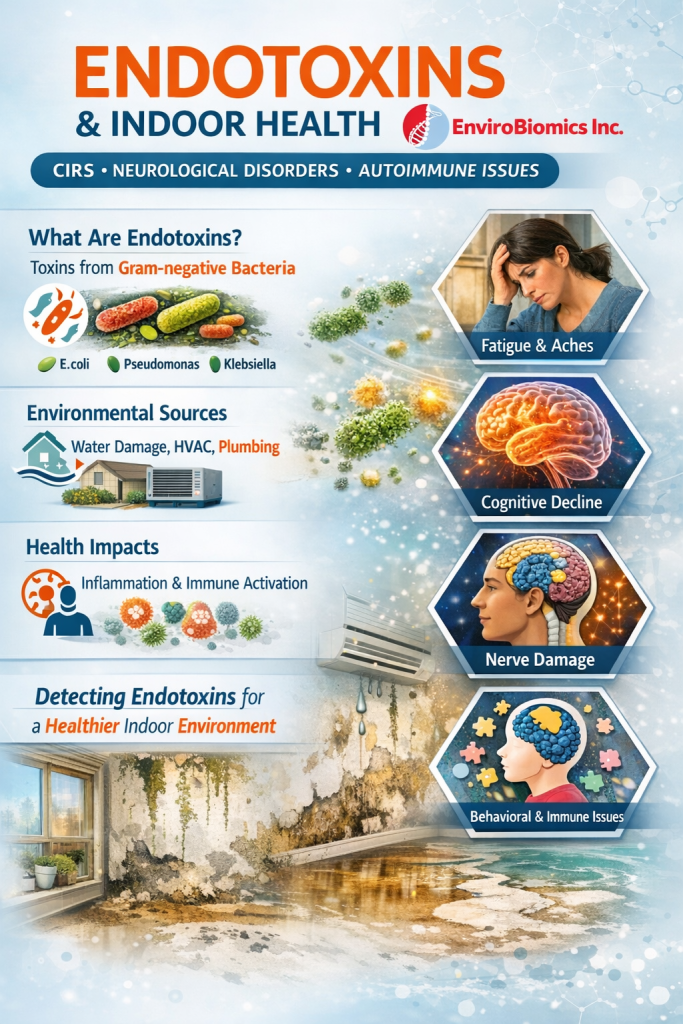
Endotoxins are inflammatory components associated with gram-negative bacteria. In indoor environments, they may be found in settled dust, damp areas, HVAC systems, and water-damaged buildings. Testing can help identify exposure patterns that may affect indoor environmental quality.
Professional web overview
This page is organized for visitors, practitioners, and indoor environmental professionals who need a clear online reference for endotoxins, exposure sources, indoor dust testing, health relevance, and prevention.
What are endotoxins?
Endotoxins are components of the outer membrane of gram-negative bacteria. They can become part of indoor dust and may be inhaled or contacted through contaminated environmental reservoirs.
Bacterial origin
Endotoxins are associated with gram-negative bacteria and may remain in dust or building materials even after bacterial cells are no longer active.
Indoor dust connection
Settled dust can collect biological particles, including endotoxins, mold fragments, bacteria, skin cells, fibers, and other environmental debris.
Water-damaged buildings
Moisture problems can support microbial growth and increase the complexity of indoor exposure conditions, especially in poorly ventilated spaces.
Exposure review
Endotoxin testing can help support a broader indoor environmental assessment when interpreted with building history and other laboratory findings.
Professional note
Endotoxin results are environmental findings. They should not be used as a medical diagnosis and should be reviewed with qualified professionals when health concerns exist.
Where endotoxins may be found indoors
Endotoxins can accumulate in dust reservoirs and may be influenced by moisture, ventilation, cleaning frequency, occupant activity, and building conditions.
Settled dust
Dust on floors, shelves, carpets, and surfaces can act as a reservoir for biological particles.
HVAC systems
Filters, ducts, returns, and poorly maintained systems can collect and redistribute dust particles.
Damp materials
Water-damaged drywall, insulation, carpet, or wood can support microbial activity if moisture is not corrected.
High-humidity areas
Bathrooms, kitchens, crawlspaces, basements, and laundry areas may require closer review when moisture is present.
Environmental context matters
Endotoxin results should be reviewed alongside visible water damage, musty odors, humidity, dust loading, HVAC condition, and other microbial testing results.
Why endotoxin exposure matters
Endotoxins are commonly discussed because of their inflammatory potential. Sensitivity and response may vary depending on exposure level, duration, and individual health status.
Respiratory irritation
In some environments, endotoxin-containing dust may contribute to respiratory irritation or discomfort, especially when dust levels are elevated.
Inflammatory response
Endotoxins can be biologically active and may be relevant when evaluating inflammatory environmental exposure concerns.
Combined exposures
Endotoxins may occur alongside mold fragments, actinomycetes, mycotoxins, bacteria, allergens, and other indoor contaminants.
Susceptible occupants
Children, older adults, individuals with respiratory conditions, or highly sensitive occupants may require more careful environmental review.
Medical caution
Symptoms are non-specific and may overlap with many medical conditions. Persistent, worsening, or severe symptoms should be evaluated by a licensed medical professional.
Endotoxin testing in indoor dust
Dust testing can help identify whether endotoxins are present in the sampled indoor environment and support a more complete environmental review.
Endotoxin testing is commonly performed using collected dust from indoor reservoirs.
Results should be interpreted with building history, moisture, ventilation, and cleaning patterns.
Useful as part of a broader indoor environmental investigation, not as a stand-alone diagnosis.
How to use results
Endotoxin findings can help guide cleaning, remediation verification, HVAC review, moisture correction, and follow-up environmental testing when needed.
Practical review sequence
- Confirm sample location: note where the dust was collected and whether that location represents typical occupant exposure.
- Review building history: identify leaks, flooding, condensation, high humidity, remediation, or musty odors.
- Compare with other findings: review mold, Actino, Myco, ERMI, or other test results when available.
- Plan follow-up: use results to support cleaning, HVAC maintenance, remediation review, or professional consultation.
Reducing endotoxin exposure indoors
Prevention focuses on controlling moisture, reducing dust reservoirs, improving filtration, and maintaining a cleaner indoor environment.
Correct moisture problems
Repair leaks, address condensation, dry wet materials quickly, and avoid conditions that support microbial growth.
Improve dust control
Use HEPA vacuuming, damp wiping, and regular cleaning to reduce dust reservoirs on surfaces and soft materials.
Maintain HVAC systems
Replace filters regularly, inspect returns and ducts, and avoid redistributing contaminated dust through the building.
Manage humidity
Keep indoor humidity controlled and avoid long-term dampness in bathrooms, kitchens, basements, and crawlspaces.
Indoor air quality actions
| Action | Professional rationale |
|---|---|
| HEPA vacuuming | Helps reduce fine dust and biological particles from floors, carpets, and surfaces. |
| Damp wiping | Removes settled dust without re-aerosolizing particles as much as dry dusting. |
| Moisture correction | Reduces conditions that support bacterial and microbial amplification. |
| HVAC maintenance | Reduces dust accumulation and potential redistribution through air handling systems. |
After remediation
After moisture correction or remediation, detailed cleaning and verification testing may help determine whether residual dust reservoirs remain a concern.
Cyano Dust ®
Price range: $245 through $260Glucan
Price range: $162 through $177C. Auris Plus
Price range: $130 through $277